

Contrary to Conventional Wisdom
The Power of Positive Feedback, a post by Carla Hanson


“I like all the S sounds. Each S makes the words slip into each other, creating a kind of dream effect.”
“I appreciate the way this piece seems to have a clear beginning, middle, and end. And the fact that the words ‘search,’ ‘sound,’ and ‘scrabble’ that appear early are echoed in the end by ‘seek,’ ‘surface,’ and ‘settle.’ The word selection helps to create the structure that seems so strong.”
“I admire the voice in this piece. The narrator is funny—the line about silage made me laugh, and yet there is a thoughtful tone, something that questions the nature of the decomposing grass, how the summer season ends with a pile of food that ends up being tossed back into an old garden.”
The above kinds of comments are typical of what one might hear in an Amherst Writers & Artists (AWA) workshop. The process is simple: the facilitator offers a prompt, an invitation—writers are always free to write about whatever they want. The group writes for a period of time—maybe seven minutes, maybe fifteen. The writing time can vary. Then, writers are invited to read their piece to the group, and listeners are asked to enter the world and the voice of the piece. Listeners are asked to attend deeply to the writing and then employ another layer of listening to themselves. How do they react to the piece? How does it affect them? What sentences, phrases, or particular words create the feeling in them? The listeners then give this information back to the writer. This reflective feedback does not require advanced degrees in English or composition or any type of degree at all. This response simply requires attentive listening.
“Writing as an art form belongs to all people, regardless of economic class or educational level.”
Think for a moment about your daily life: Think about the number of interactions, conversations, the times you engage with others. How many times do you truly feel heard? When writers experience an AWA workshop for the first time, the sense of being heard and understood can be quite profound; having their writing attended to and responded to without judgment can reignite or create a love of wordsmithing.
Of course, some critics question or challenge our method. They say: It’s just another way to give participation trophies; the process lacks academic rigor; it’s anti-intellectual; you can’t teach craft without pointing out mistakes. Whatever the critique, I can guarantee it is an argument that runs counter to two of AWA’s Essential Affirmations: “Writing as an art form belongs to all people, regardless of economic class or educational level” and “A writer is someone who writes.” If you listen carefully to the above protestations, you just might hear that metallic sound of the clasp on a gate closing.
The idea that learning to write requires a teacher committed to pointing out errors and mistakes without awareness or respect for the actual writing process reminds me of the saying I’ve seen on posters and t-shirts: The beatings will continue until morale improves. This traditional approach ignores the writing process and the way people actually learn.
Now, think back to your formative writing years. Recall a time when your love of writing, your fascination with this form of communication, this magic, was not fostered. As a retired public school teacher, I fear that most of you will remember a time in school when your teacher returned a paper that you’d written days and possibly weeks earlier. The paper likely had a grade or points written in red ink at the top. There might be comments on the paper, maybe a short sentence or two in the margins or at the end. There might be several red circles, indicating problems with spelling, syntax, subject-verb agreement—a host of other technical terms that made you feel ineffective, made you feel stupid, eviscerated you, made you think, Why bother? You might have tucked the paper into a notebook, squished it into your backpack, or tossed it into the bin as you exited the class. As I write this, I feel my body deflate, curve forward in a protective gesture, and I slouch out of this imaginary classroom, feeling like I’m a failure, knowing that if I were that student, I might never try to write like that again.
Contrast this classic classroom experience with how a writer feels after a group of peers reflects the ways a piece was strong or stayed with them. Instead of curving forward in defeat when I imagine this scenario, my body feels buoyant; I can’t help smiling. After a workshop like this, I am eager to return to a piece of writing, elated to know that certain sections work and other sections could be strengthened. Perhaps I’ll add some dialogue. Rachel’s piece had dialogue, and everyone commented that they liked that element.
In Pat Schneider’s 1993 book, The Writer as an Artist: A New Approach to Writing Alone and with Others, she says that her “methodology for writing workshop minimizes hierarchy and maximizes human wisdom” (137). When writers write in an AWA workshop, the role of the teacher, the sage on the stage, the all-knowing one, the one who knows about the arcane science of sentence diagramming, is non-existent. There is no “expert” to tell the writer what is right or wrong. That binary doesn’t exist.
Instead, we are a circle of writers who listen deeply to the piece; we enter the world that we’ve been given, and then give the gift that a writer doesn’t normally receive—immediate reaction from an audience of how the piece lands sans critique or judgement—just the simple human wisdom that says, Ahhh, this part of the piece connects with me.
Think about feedback like this: It is immediate; it is sometimes based in the body (some listeners tell how they felt while they listened); sometimes the input is more analytical; the listener identifies something deeper or metaphorical that the writer didn’t know was there. This naming, this acknowledgement, is always powerful, especially when the writer is struggling and can’t see their skills or their strengths.
One of the most powerful parts of this response protocol is that the audience tells the writer which sections of the text elicit their response. Maybe the writer is going for ambivalence. If so, they get to delight in realizing how their word choice accomplished that. Perhaps the writer doesn’t want to create a sense of ambivalence. Again, they have invaluable information that a particular set of words created a sense of uncertainty, so the potential revision is clear—make different word choices.
When I listen to other writers, I pay attention to what grabs me so I can report this to the writer, but I also note that for myself. Let’s say I notice that someone’s writing feels muscular and action-packed, but I’m not quite sure why. Another writer then comments that the piece uses active verbs. Aha! Now I know why. Perhaps as an inexperienced writer, I am not sure what that means, but after the workshop, I Google “active verbs” and get the usual grammar book verbiage, abstract and off-putting. However, in the workshop, I saw the power of strong verbs in action, and I plan to emulate that writerly move. Again, think back to any time in your formal education where a lesson about active verbs stands out in your mind. Then imagine what it would be like to have listeners comment on your vivacious verbs. Which approach is better in teaching that craft element?
And what about the writer whose writing was strong and muscular? How does this writer benefit? Perhaps they were consciously strengthening their piece with verbs, but maybe they wrote this way unconsciously. Either way, they get assurance of the value of those choices. After hearing the strength-based feedback, they now understand how to beef up sections of a piece that seem inactive by comparison. Again, a powerful lesson in craft that didn’t require the red-ink punitive message implying: This is wrong. You should do it this way. Nope, not good enough.
The elegantly simple AWA protocol has many facets and nuances. Still, the effectiveness of limiting the feedback to only strength-based responses to brand-new writing does much of the heavy lifting. The message is made explicit that all writing is welcome; all voices are welcome, and all who are gathered in the circle have committed to listening and observing. We prime ourselves to see what is working; we will not focus on what isn’t working. (There is time for that, but it comes later in the writing process.) This witnessing lens changes both observers and the writers.
The founder of AWA, Pat Schneider, often said, “If a writer leaves a workshop feeling like writing, it was a good workshop. If they leave feeling like they never want to write again, it was not a good workshop.” After every AWA workshop I’ve attended since 2007, I have left with a lightness in my step, eager to write again. Can I say the same about the many other workshops and writing classes I’ve taken? Sadly, no.
My experience isn’t unique. I can’t tell you how many times I’ve been in an AWA workshop where writers explain how a competitive MFA program squelched their love of writing; how the academic world silenced them for years, maybe decades. In the AWA ranks of writers and trained facilitators are scores of individuals who hold MFAs and PhDs, who testify to how the AWA Method reignited their love of writing.
The fundamental question of a rhetorical analysis is: What is the overwhelming effect of this piece, and how is it achieved? So, in the simple wisdom of a circle of writers who listen deeply and then report how the writing impacted them, we have the basic rhetorical analysis. The AWA Method challenges the conventional wisdom that writers have to know what they are “doing wrong” to write better. We say that knowing what they are doing “right” is much more apt to encourage them to write more, experiment more, and see themselves as writers. We understand that the lack of hierarchy and the welcoming lens of looking for what is strong are part of the magic that helps develop writers.
The overwhelming effect of Amherst Writers & Artists workshops is that writers keep returning; they keep writing; they learn to still the inner critics; they don’t say to themselves, Why bother? They write and write and write, honing their craft. They revel in the process, and, I’m sure it’s no surprise, but they also complete projects and publish them.
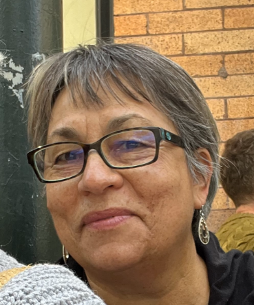
Carla Hanson has been an AWA facilitator since 2007. She served on the AWA board for six years and continues to participate in a number of AWA programs. She holds a master’s degree in Composition and works as a Teacher Consultant with the California Writing Project. Before retiring, Carla taught in California public schools for three decades. Carla grew up in northwestern Montana on the Flathead Indian Reservation and is a member of the Confederated Salish & Kootenai Tribes.
Schneider, Pat. The Writer as An Artist: A New Approach to Writing Alone and with Others. Lowell House, 1993.

This gorgeously crafted essay resonates deeply with me. It describes in beautiful detail the gifts of the AWA method, its effective and positive impacts on writers, and how much it contrasts with conventional methods of teaching writing that can be damaging and may silence writers.
Your images are powerful, including the physical reactions of the body that can result from specific circumstances.
What an inspiring tribute to why we share this practice with others and the way effective feedback assures the writer that he or she has been heard, including what was strong and stayed with the listener.
Thank you for taking the time to share this wise, supportive piece with us, Carla!
Thanks, Carla, for this wonderful piece reminding me why this process works so beautifully. You included references to the bodily responses to each method, contrasting deflate, slouch with buoyant, lightness in my step. When you quoted from Pat's book about the traditional way, "The beatings will continue until morale improves." I burst out laughing. You used the word, "love", four times. I don't know if that word is used in any MFA literature. It is fitting that it is here, as love flows in the piece, in the practice, and in the life of the participant whose love for writing grows. Thank you, again, Carla. And thank you, Pat, always.