

Write Your Art Out!
…in which Barbara Krasner and Susie Whelehan invite you to explore Ekphrastic Writing

Come on along. It’ll be fun!
Susie: All art is an invitation to engage with the artist. Usually, we do this in our minds, and we may ultimately voice our impressions and responses to others. With Ekphrastic writing, we are invited to write down our descriptions, impressions and responses in whatever way appeals to us. Imagine! And you need have NO EXPERIENCE WITH ART HISTORY CLASSES OR BE A VISUAL ARTIST YOURSELF. Whew!
Ekphrasis is a Greek word meaning “to describe” and Ekphrastic writing began with simply writing a description of a piece of art. While most early examples are poetic, see Homer’s “Shield of Achilles”. See Keats’ “Ode to a Grecian Urn”, some more recent prose writers also included ekphrastic writing in their work: see Melville’s description of the whale in Moby Dick and Donna Tartt’s treatment of the painting in The Goldfinch.
There are no limits to how you can respond to a work of art. Of course, you can describe it, and in doing so, focus on, say, a particular colour that reminds you of another work of art, and another and another….Or it might be the brush strokes used in the painting that catch your fancy, leading you to ask the artist what mood they were in when they were painting…and actually get a response.
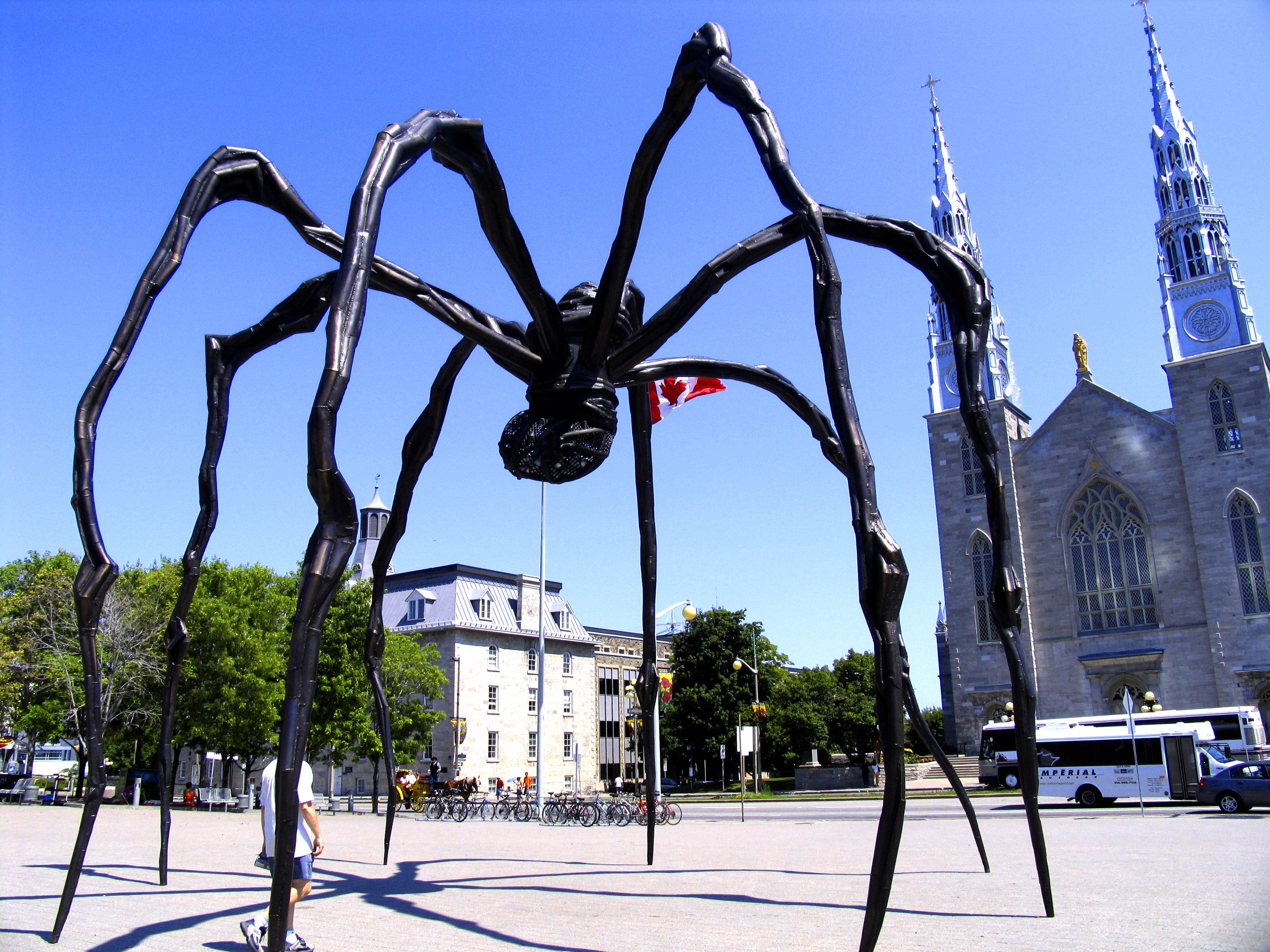
Frida Kahlo and Emily Carr each painted their pet monkeys. You might write letters they wrote upon seeing each other’s work. What if Louise Bourgeois’s spider, Maman, decided to move?
What might The Thinker be thinking? How about going for a hike through one of Ansel Adams’ forests, or speaking in the voice of an Aspen? When have you felt as silly as Einstein in Sasse’s photo, or as lonely as Picasso’s Guitarist? What made Munch’s Screamer scream?
Ekphrastic writing may take you back to your childhood, cause you to question the status quo, or propel you forward to the next century and write a manifesto for a peaceful world. It may arouse your passions or quiet your demons. All that is required is to accept the invitation to look…and have your pen ready!
2. What catalyzed your interest in writing in response to art?
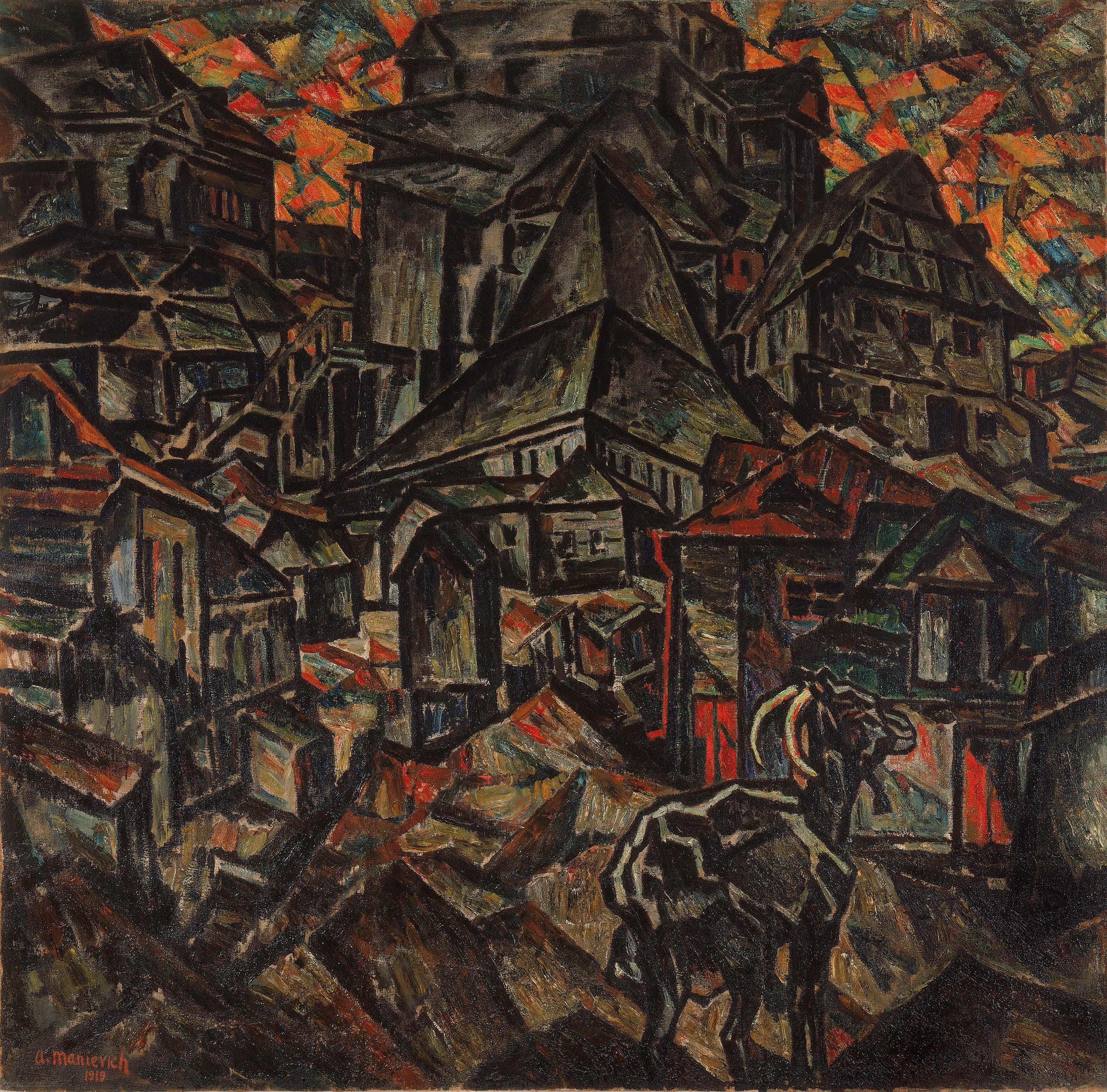
Barbara: My first attempt at writing in response to visual art came from a tour of the Jewish Museum I sponsored in 2014. A docent led us to three paintings. She explained the painting, discussed the artist’s background, and gave us time to record some type of reaction. One of those paintings was Abraham Manieovich’s Destruction of the Ghetto, Kiev (1919). In this painting, I saw the destruction of my grandparents’ villages in Poland during the Holocaust. I wrote a poem, and it appeared in the now-defunct Poetica Magazine. From that point on, certain works of art catalyzed memories or associations, making me think: I want to write to that! I came upon The Ekphrastic Review’s biweekly writing challenge in January 2024, and as editor Lorette C. Luzajic maintains, I got hooked on ekphrasis. Every two weeks, I studied the image offered as a prompt and tried to find something in it. My first piece was in response to a painting by a Polish artist, and it reminded me of my 2008 trip to my grandfather’s village. Please note: I had zero prior knowledge of art. But my foray into ekphrastic writing motivated me to check out the webinars by Smithsonian Associates (once mentioned to me by AWA facilitator Marian Calabro) and ultimately, I earned a certificate in World Art History.
Susie: I can’t remember the first time I wrote an Ekphrastic piece, but I do know that I use art as writing prompts all the time, and I have always loved seeing the ways many people choose to respond to the same work of art. And I appreciate that my response is as valid as anyone else’s, even when I don’t have any knowledge of the artist, or the style/era/anything! I accept the invitation to respond.
3. What are the challenges and the satisfactions? Benefits?
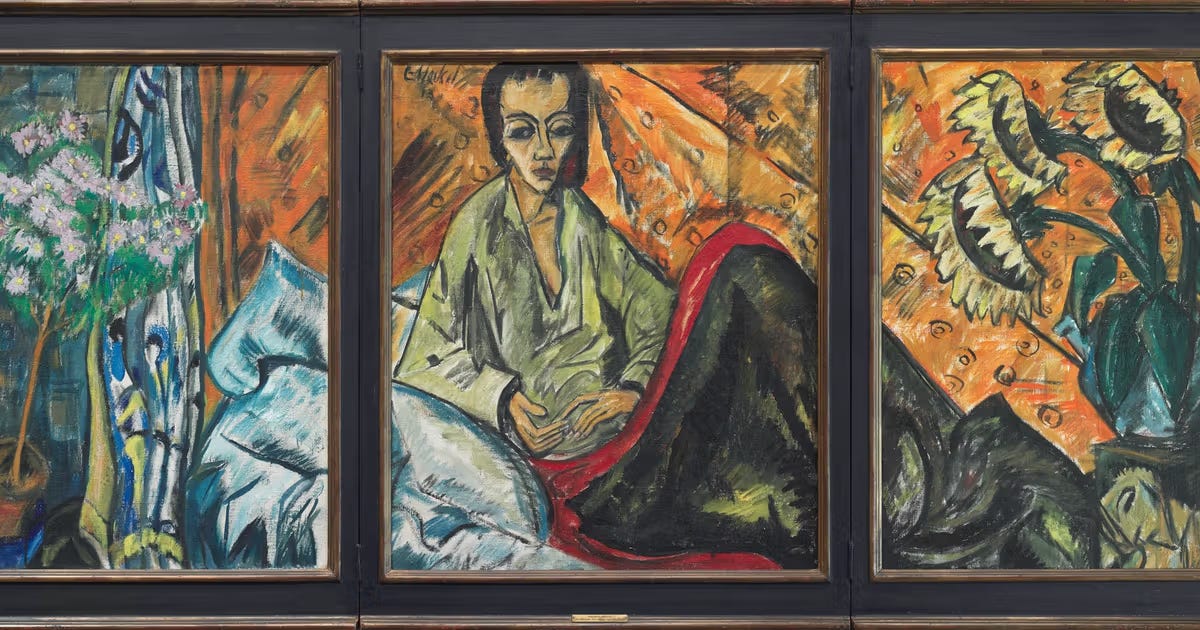
Barbara: Art, in general, helped me deal with the confluence of multiple chronic conditions in 2024-2025. I was caught in an immunocompromised bubble caused by a COVID booster-triggered autoimmune disease, rare and incurable. I turned to art. I needed to envelop myself in a different reality. I flipped through art books about specific artists or museums. In particular, I studied Frida Kahlo, who painted through the limitations of her body, and Lee Krasner, who also had insomnia (after the death of her husband, Jackson Pollock). As soon as I was medically cleared, I headed out to Long Island to visit the Pollock-Krasner House. Writing in response to art has given me a way to look past my own infirmities and focus on the line, the shape, color, and texture. I’ve fallen in love with all sorts of art, from the Dutch masters to surrealism and abstract expressionism. I pull my rollator up to a painting, sit, and ask myself: What do I see here? I begin writing in my head. So far, I’ve written and published essays about this process, including “I Trip the Light Ekphrastic: An Autoimmune Journey” and the forthcoming “Artful Tasting Menu.” Dozens of poems have resulted as well, including one of my favorites, “My Convalescence, a Triptych, “ a prose poem written in response to German expressionist Erich Heckel’s To the Convalescing Woman, a triptych I saw at The Neue Galerie in New York City.
The challenges might be the same as with any writing. Drafting, revising, revising, revising, submitting, rejection, submitting again. But the satisfactions aren’t in publication. It’s in connection with a piece of art, with someone else’s creation, and with the artist, too.
Susie: The challenges come as they do with every piece of writing – editing my draft to create the best piece I can, in whatever style I choose, so that it is a worthy response to that original work of art. The satisfaction comes from meeting the challenge. A benefit is the immediacy of interacting directly with the artist, no matter what their spoken language, and not needing a translator as you might for a written work. There is no intermediary between you and the art for you to respond. Now, you may choose to learn about the artist or the subject matter, and then appreciate and respond in brand new ways. The possibilities are infinite… As well, if you are a visual artist, you have the chance to enhance your own work with your creative writing. Imagine.
4. How to get started
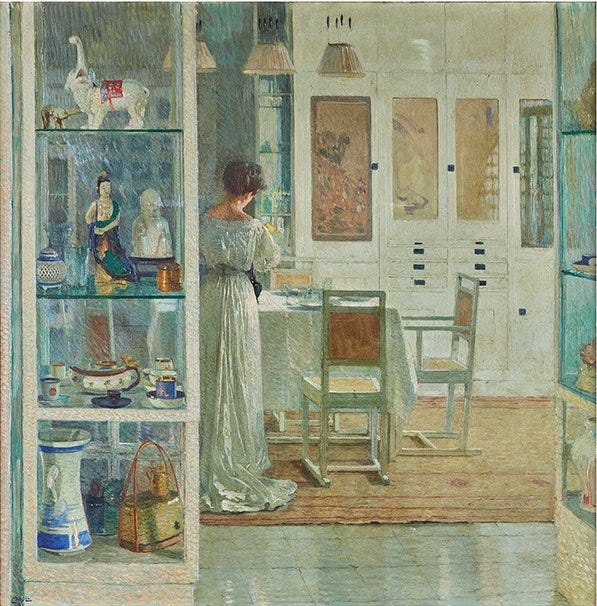
Barbara: Flip through an art book or stroll through a museum or gallery. Does any work of art reel you in? Ask yourself what you notice. What are the horizontal lines, the vertical lines, the angles, the colors, the textures. Hold off on interpretation. Just focus on what you see. Jot down those thoughts. Then make a connection, either with the art or artist or a memory. At the Baltimore Museum of Art, I fell in love with a work by Matisse, Festival of Flowers. Two women on a balcony observing a parade of flowers in Nice. I thought of my 2024 trip to Paris with my college roommate. Or, at the Neue Galerie, on the landing of the Austrian floor, I was gobsmacked by a 1905 Carl Moll painting, The White Interior, in which a woman with her back to the viewer arranges flowers. That woman turned out to be my grandmother’s distant cousin’s wife. Be open to all ideas when you encounter a work of art.
Take a trip to a local art museum. Stroll through. Look at the art first without reading any wall text. What moves you?
Susie: You might start with an artist you know and like, choose one piece, and respond to it in several ways: describe it by subject matter, style, colour, composition, shading etc., interview the artist as to inspiration, mood, choices made, give voice to a character/object in the work, explore what it reminds you of in your own life, how it makes you feel… When you have tried it several times with artists you know, step out into the wider world and have fun!
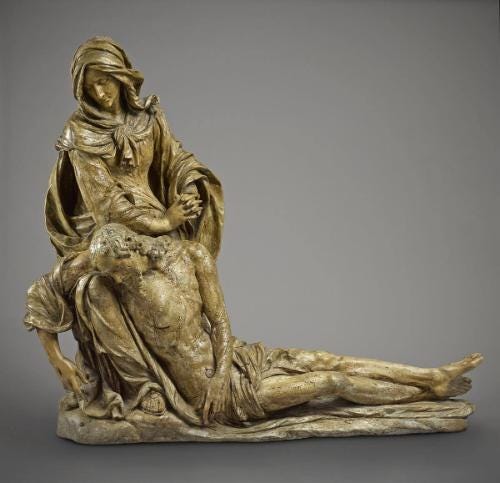
At the Art Gallery of Ontario, I saw the Pieta that Nicolas Van Der Veken carved out of wood in the 1600s. Christ was draped across his mother’s lap, his head turned to the ground, and she sat with her hands folded, a calm expression on her face. What? I immediately felt compelled to write to him and ask him if he ever showed this to his mother who would have immediately told him no mother would be able to keep her hands off of her dead child’s body. I mean, come on, Nicolas! See? You can challenge the artist. It’s very satisfying.
5. Workshops and resources
Barbara: The Ekphrastic Review publishes new work daily. This literary magazine, through its Ekphrastic Academy, also offers excellent workshops led by the incomparable Lorette C. Luzajic, including upcoming ones on Surrealism, Women Abstract Expressionists, Impressionism, the Ekphrastic Haibun, and more. There’s an annual Facebook-based marathon every July: Choose 14 images to write to (poetry or flash fiction/nonfiction) and you can submit up to five pieces to the magazine.
Lorette’s Fifty Shades of Blue offers fifty art-based prompts. Several other “starter” ebooks provide inspiration. Moreover, this literary magazine offers a nurturing community, and I have delighted in seeing some of my workshop participants getting published here.
The Light Ekphrastic pairs you with an artist for a collaboration. When the editors accept a submission, you choose from three of the artist’s works to write to, and the artist chooses from three of your works to illustrate.
Check out the Art & Architecture webinars by Smithsonian Associates. They range from addressing specific art movements to specific artists to surveys such as Introduction to American Art and Introduction to British Art. Mary Hall Surface is a favorite instructor who holds generative writing sessions in response to a particular painting, “the art partner.”
Many museums also offer workshops online, including one of my favorite museums, The Barnes Foundation, in Philadelphia.
Bio
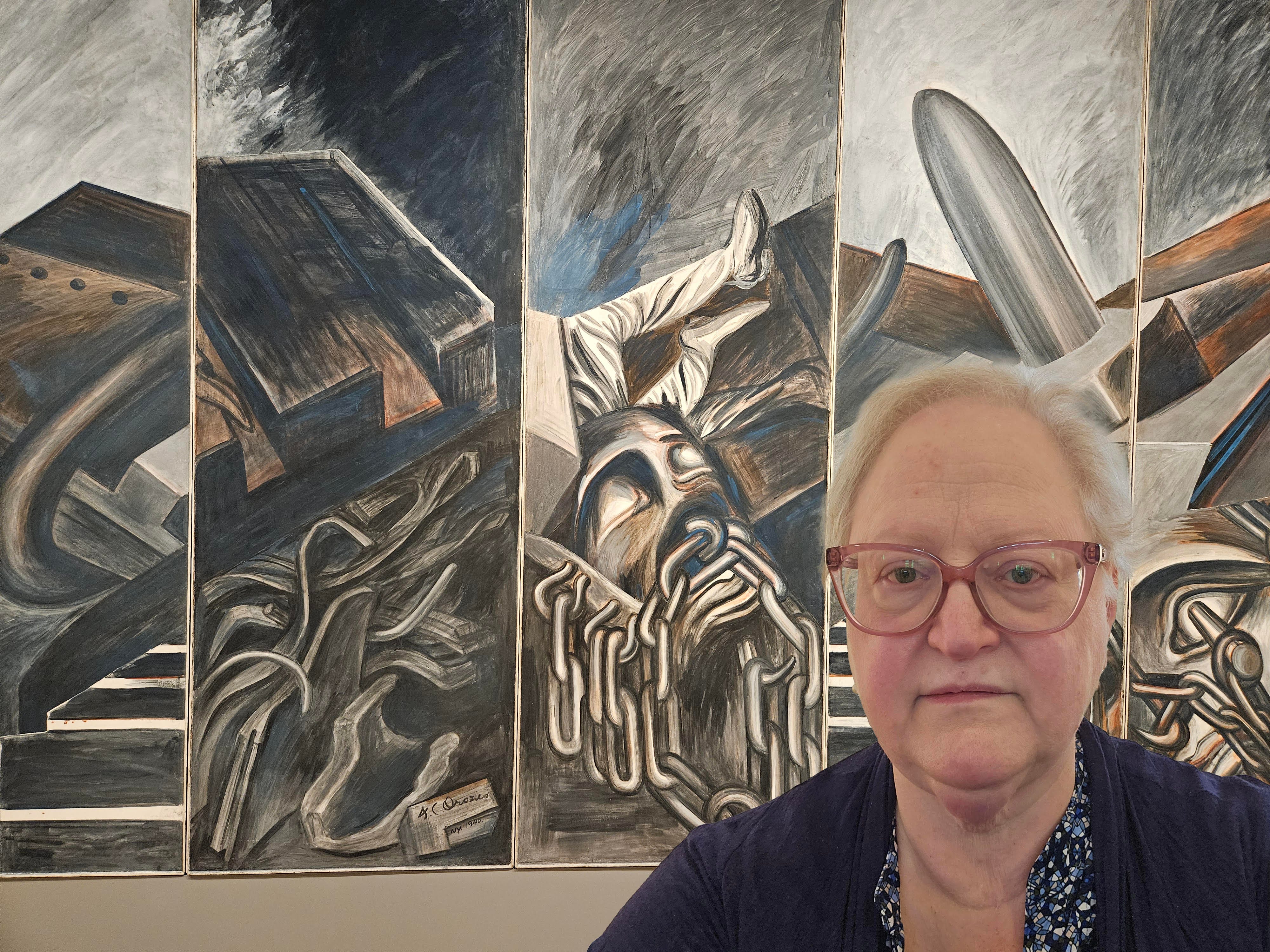
Barbara Krasner, dubbed “The Ekphrastic Warrior” by The Ekphrastic Review, leads AWA workshops for River Heron Review and Consequence Forum in response to visual art. Her work has appeared in more than seventy literary magazines, earning her Best of the Net, Best American Short Stories, Best Microfiction, and Pushcart Prize nominations. She is the author of the ekphrastic collections, Poems of the Winter Palace (Bottlecap Press, 2025), The Night Watch: Poems (Kelsay Books, 2025), Insomnia: Poems after Lee Krasner (dancing girl press, 2026), and the forthcoming The Wanderers (Shanti Arts, 2026). She hosts The Ekphrastic Book Club for The Ekphrastic Review and serves as guest curator of the Ekphrastic Review Biweekly Writing Challenge. She also serves as co-editor of Kelsey Review, the literary magazine of Mercer County Community College and offers ekphrastic writing sessions in the college’s art gallery. She lives and teaches in New Jersey.
Susie Whelehan is a reader, writer, seeker, sister, Aries, artist, wife, mother, grandma. Her writing has been published by Novalis, Knopf/Random House, The Globe and Mail, The Toronto Star. as well as various journals and anthologies. Her poetry collection, “The Sky Laughs at Borders”, was published by Piquant Press. Susie is a member of the League of Canadian Poets. She will tell you that Pat Schneider is right up there with Sara Lee and Bruce Springsteen when it comes to people who have made her life richer and happier, and that AWA changed her life. Go ahead. Ask her.
Susie has had the pleasure of attending workshops on Ekphrastic poetry led by our very own prolific Barbara Krasner, who introduced her to the Ekphrastic Review and the remarkable Lorette C. Luzajic. She has since had several poems published in the Ekphrastic Review. She lives and writes in Toronto, where she offers AWA workshops in person and online for small groups who seek her out for “An Oasis at Your Request” on her website: susiewhelehan.ca. You can also contact her at swhelehan@gmail.com.
Amherst Writers& Artists’ next online write is on Friday, May 15, at 1 p.m. Eastern with Pennie A. Nichols. All are welcome to experience the magic of an AWA workshop. Join us
PENNIE A. NICHOLS is a Louisiana-based author of literary fiction whose novels and stories explore the intersections of identity, community, and connection. Alongside her own writing, she facilitates in-person workshops, meetups, and retreats that help writers tap into their creative flow. Recently certified as an Amherst Writers & Artists affiliate, she plans to offer online InkWell WordShops and Draft and Craft series. A regular contender in flash fiction and poetry contests, Pennie is passionate about fostering safe spaces for creative expression.
 | A guest post by
|
Sounds great. When will the workshop take place?